


أجهزة الاستشعار المدفونة مقابل الأسوار الإلكترونية: أي نظام من أنظمة كشف التسلل يفوز؟
Release time: 2026-03-19
Your boundary is your first line of defense, but traditional solutions often have major blind spots. Cameras miss intruders in fog or dark hiding places, and fences can be cut or climbed. How do you know when a real threat has arrived? The most challenging intrusion behaviors go undetected until it is too late.
Traditional perimeter security relies on visible barriers and passive alarms, leading to constant false positives and surveillance fatigue. High-security facilities demand a smarter, more resilient, and invisible layer of protection that attack the intruder’s movement at a fundamental, physical level. Modern security forces need a system that offers sub-second response times and precise positioning.
To build a zero-leakage workplace, you must choose a technology that cannot be seen, cannot be bypassed, and adapts to any terrain. This article compares two industry titans—buried sensors and electronic fences—to help you decide which Intrusion Detection System reigns supreme for your critical infrastructure.
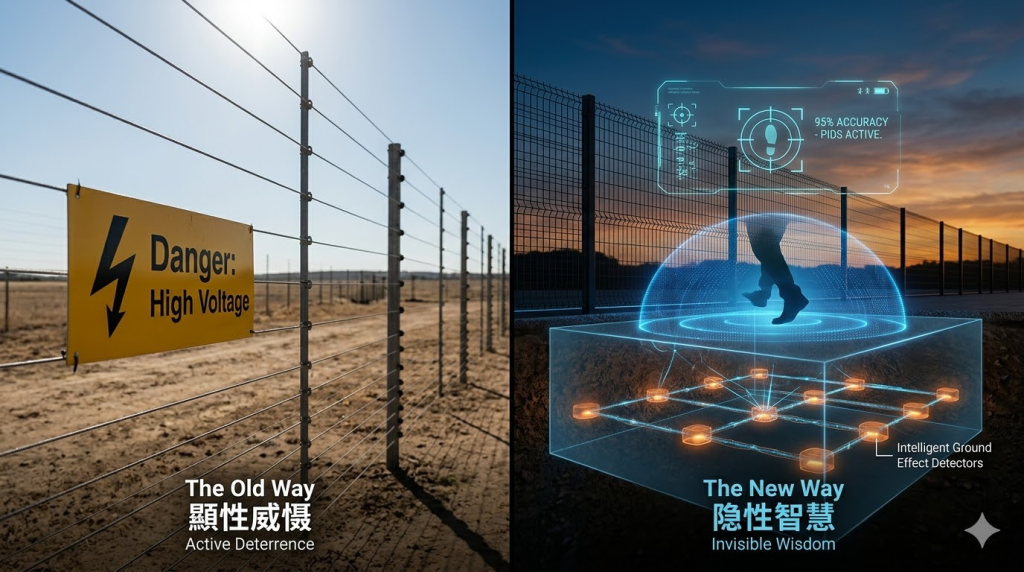
The Buried Sensor and Electronic Fence in Contemporary Security
Before diving into the technical details, it is important to understand what role these technologies play in a contemporary security architecture. We are moving beyond simple barriers toward an integrated “nerve system” of data-driven defense.
A. Visible Deterrence vs. Invisible Protection
The electric fence’s primary power is visibility. It acts as a massive psychological deterrent, loudly proclaiming that unauthorized entry will be painful. However, this visibility is also a weakness. Professional intruders can observe the fence, identify power sources, or find ways to bridge or ground the system before an alarm is even triggered. In contrast, buried sensor technology offers the power of invisibility. An intruder cannot sabotage a security measure they cannot see.
B. Reactive Alarms vs. Intelligent Sourcing
Most entry-level electronic fences are reactive: they alarm after a person touches them or completes a circuit. Advanced Perimeter Intrusion Detection System (PIDS) solutions, particularly those using microwave array intelligence, create a proactive three-dimensional detection induction field. These systems analyze signal changes at the source, allowing security personnel to understand the nature of the intrusion—be it climbing, cutting, or underground tunneling—before the intruder even clears the perimeter.
The Battle of Intel: Eliminating False Positives
False positives are the single biggest challenge in perimeter security. In a busy industrial park or near a prison facility, constants alarms due to wind, branches, or small animals lead to monitoring response fatigue. When a real alarm arrives, it might be ignored.
The technical gap between the two technologies becomes clear when analyzing detection logic:
The Problem with Vibration Sensing: Standard electric fences, especially those relying on fiber optics or simple vibration sensors attached to the mesh, cannot distinguish between a human climbing and a tree branch hitting the fence in a storm. Security supervisors spend hours investigating non-threats, depleting security resources.
The Intelligence of Microwave Arrays: A state-of-the-art Ground Effect Detector uses complex intelligent algorithms and CAN bus communication to process data per independent defense zone unit. The system is calibrated to ignore unintentional touches, jumping small animals, and common environmental noise. This results in a certified working alarm rate of ≥95%, providing rock-solid reliability that allows commanders to deploy response forces only when necessary.
Adaptation and Deployment: A Decision for Operational Efficiency
The final decision often comes down to operational efficiency. Where can the technology be deployed, and how long will it last in brutal industrial environments?
Terrain Restrictions: Electric fences must follow the precise contour of the physical wall or anti-climbing net. Geological conditions must be stable. Buried ground effect sensors are not restricted by geology; they function effectively in soil, asphalt, or cement. The flexible deployment methods allow for camouflage, placement in bushes, or even underwater deployment to create a truly unnoticeable barrier.
Maintenance and Health: High-voltage electronic fences require constant maintenance to clear vegetation and prevent environmental shorts. More importantly, they pose a safety risk to authorized personnel or the general public. Systems utilizing passive collection technology have zero health impact on the surrounding population and require almost no physical maintenance once deployed.
Conclusion: Securing the Final Boundary
Perimeter security is no longer just about building a higher wall or a sharper wire. It is about intelligence and resilience.
In the high-stakes environments of prisons, airports, and military bases, traditional electrified fences provide a necessary layer of visible deterrence, but they lack the granular intelligence required for proactive defense. By integrating an invisible, intelligent layer based on Ground Effect Detection technology, organizations can finally close the loop on their security strategy. This synergistic approach ensures that you are not just reacting to intrusions, but are actively predicting and neutralizing them before they can compromise your assets.

