غير مرئي للكاميرات، واضح لك: شرح نظام مكافحة الكاميرات الأمثل
Release time: 2026-03-05
In the landscape of modern cybersecurity, we have mastered the art of digital defense. Firewalls are robust, end-to-end encryption is standard, and multi-factor authentication is ubiquitous. Yet, a cavernous, low-tech vulnerability remains hiding in plain sight: the final physical screen.
You can secure the network, but you cannot easily stop an insider or visitor from pulling out a smartphone and taking a high-resolution photograph of sensitive data displayed on a monitor. This single action bypasses millions of dollars in digital security infrastructure in less than a second.
To address this critical blind spot, a new paradigm of data loss prevention has emerged. This article explains the technology behind a revolutionary anti-camera system —a hardware-level solution that renders screens invisible to recording devices while maintaining crystal clarity for authorized personnel.
The Physical Screen: The Final Frontier of Data Loss Prevention (DLP)
Traditional Data Loss Prevention (DLP) strategies focus heavily on software protocols. They effectively prevent unauthorized copying, emailing, or printing of confidential files. However, the moment that data is rendered on a monitor, its security is compromised by the physical environment. The rise of high-definition smartphone cameras has turned every employee and visitor into a potential leak source.
When we discuss a “confidential meeting,” we are often referring to discussions surrounding information that cannot leave the room. Yet, standard monitors provide no inherent protection against visual capture. Once a photo is taken, that data is completely outside of the organization’s control—it can be shared instantly, encrypted by a third party, or leaked publicly without a digital footprint.
Standard privacy filters—the micro-louver films that obscure side viewing angles—are ineffective here. They do nothing to stop a smartphone held directly in front of the screen. We need a solution that attacks the optical capture capability of the recording device itself, which is where advanced spectroscopy comes into play.
Explaining the Technology: How Multi-Frequency Spectroscopy Decodes Security
This is not a simple software patch or a passive film; it is a complete Multi-frequency spectroscopy hardware system. To understand its power, we must understand its architecture. The system is composed of three critical components: a dedicated hardware host, specialized filtering eyewear, and high-speed signal processing.
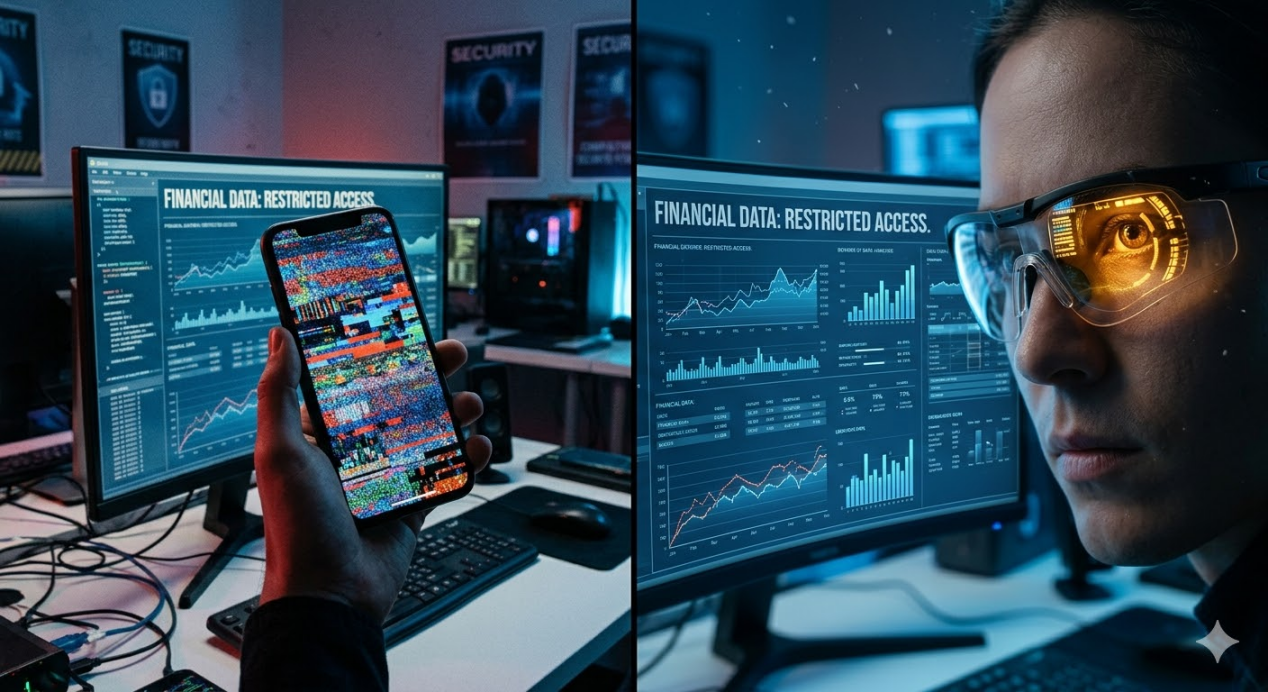
Hardware-Level Encoding: The system installs directly between the signal output (e.g., a secure PC) and the content carrier (the monitor). The hardware host captures the clean video signal and applies a complex, high-frequency cryptographic encoding process. It effectively “scrambles” the signal at an optical level before it reaches the display.
The Resulting Display: To the naked eye, or to any camera lens (smartphone, DSLR, security camera), the screen appears to display random, unreadable, garbled noise, severe optical artifacts, or a completely distorted image. The useful information is optically encrypted.
Optical Decoding: The authorized user is equipped with special glasses featuring optical decoding privacy glasses properties. These are precision-tuned to the exact frequency and spectroscopic patterns used by the hardware host. When viewed only through these correctly filtered lenses, the scrambled image is instantly decoded, revealing the original confidential information with perfect clarity.
This is a fundamental shift: the security is bound to the physics of light rather than just a software permission. The screen is “Invisible to Cameras, Clear to You.”
Advanced Features Built for Corporate and Government Intelligence
Beyond the core ability to nullify a camera’s effectiveness, a robust anti-camera system must integrate into a broader security ecosystem. The YuanXiang system, for instance, includes critical features designed for enterprise-grade manageability and accountability:
QR Code Leak Attribution and Tracking: A primary concern for security directors is “attribution”—if data leaks, who leaked it? Each output terminal generated by the host includes an independent, imperceptible (to authorized viewing) two-dimensional code. If an unauthorized attempt were made to circumvent the system (e.g., by a high-end, custom-tuned sensor), the resulting image, if partially recovered, would contain a forensic watermark. This allows the source of the leakage to be traced instantly back to the specific terminal, date, and time.
Centralized Network Control: Large organizations cannot manage security on a device-by-device basis. The entire system is network-connected and managed by a central terminal. A host management terminal controls use rights, access levels, and active periods for every anti-shooting node in the network. This allows an IT director to activate the anti-camera function globally for a recurring classified briefing and deactivate it for public usage.
Authorized Access Control: The system can be paired with identity management tools, such as the fingerprint recognition system, ensuring that only authorized personnel can activate the decoding sequence of their specialized glasses, adding another layer of authentication.
Critical Use Cases: Where Physical Data Protection Is Mandatory
The technology is essential for environments where the cost of a visual data leak is catastrophic.
| Industry Sector | Primary Application | Pain Point Solved |
| Government & Military | Secret workplace, Command & Control rooms | Prevention of photographing classified documents, satellite imagery, or electromagnetic leak intelligence. |
| Corporate Boardrooms | M&A discussions, financial forecasting, strategic planning | Stopping insiders or guest attendees from capturing pre-market financial data or secret strategies. |
| R&D & Manufacturing | Blueprint review, industrial design, proprietary software code | Preventing “visual industrial espionage” by stopping competitors from photographing prototypes or schematics. |
| Data Centers | Network architecture review, security protocol visualization | Preventing the visual mapping of physical security infrastructure or network topologies. |
Conclusion: Securing the Analog Gap in a Digital World
We live in a digital world, but we interact with it in an analog, visual way. The final physical monitor is an analog gap that digital security cannot bridge. As camera technology continues to improve, the threat from visual data theft will only grow.
By implementing a hardware-based, active anti-camera system, organizations can finally close this loophole. This technology ensures that confidential data remains confidential, not just while it resides on a server, but also in the crucial moment it is viewed and discussed. Contact YuanXiang today to discuss how this optical decoding solution can redefine your physical data protection strategy.